Lead Engine
AI-powered prospecting platform for local businesses
- SaaS product
- Dashboard
- AI automation
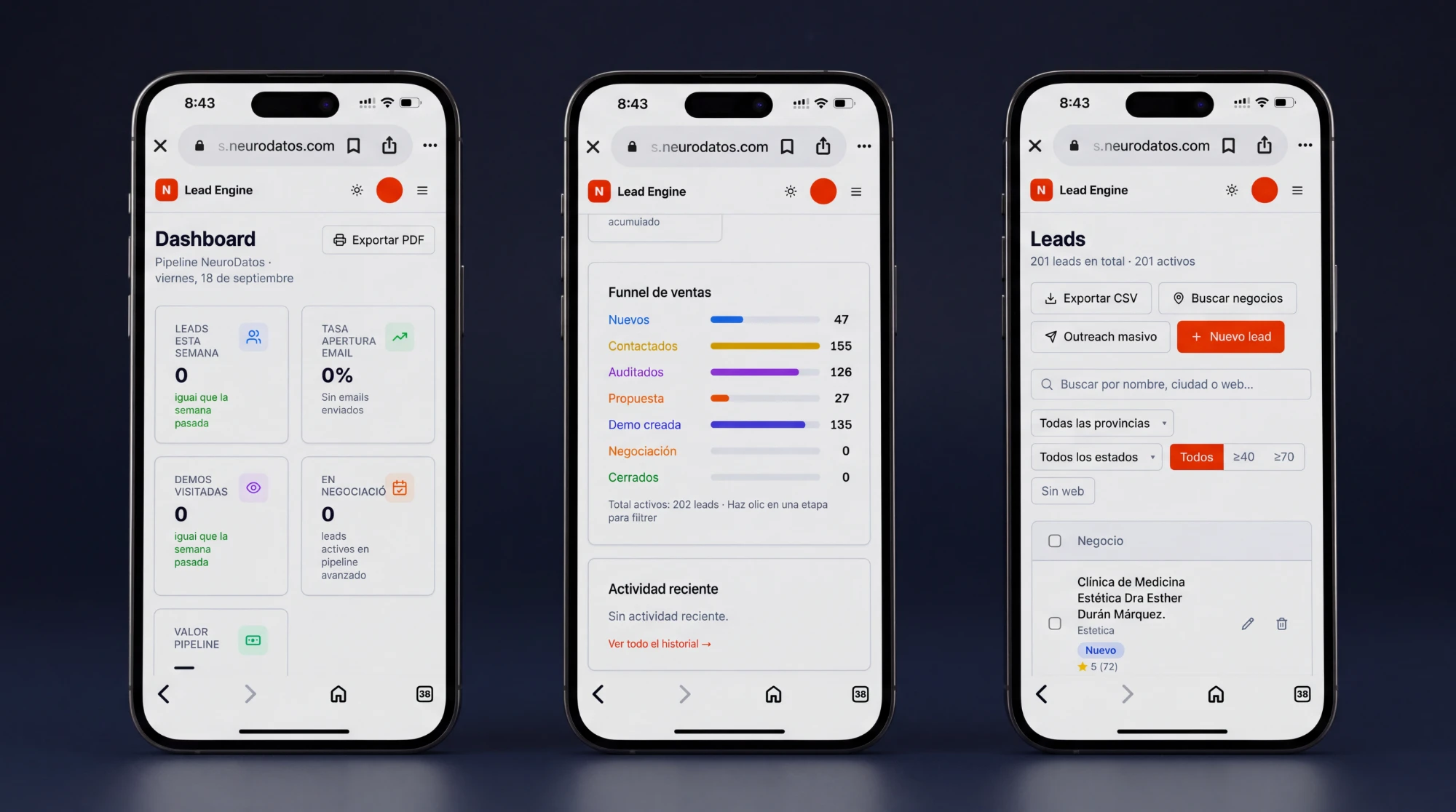
Lead Engine is a prospecting platform I designed for NeuroDatos, my AI automation agency. It finds local businesses with a weak or missing web presence, in any sector and any city, audits their sites automatically and generates outreach that cites exactly what is wrong and how to fix it, instead of a generic sales pitch.
Role: product and UX design. Built first for NeuroDatos’ own sales pipeline.
The problem
Most local businesses, such as a dental clinic, a law firm, a car workshop or a padel club, share the same issue: an outdated website, no online booking, a poor mobile experience, or no site at all. They rarely know what it costs them in lost customers, and they have no reason to trust a cold pitch that does not prove it understands their situation.
For an agency the challenge is the mirror image: finding these businesses at scale, across every sector worth targeting, and reaching out with something that feels researched rather than templated, without spending hours on each lead.
The solution
Lead Engine was designed from the ground up to be sector-agnostic: the same engine that finds dental clinics in Seville can find HVAC installers in Madrid or law firms in Córdoba, with no reconfiguration beyond typing the search term. It works in five stages:
- Discovery: businesses are found by free-text category and location.
- Audit: an automated site crawl and performance checks score SEO, performance and accessibility, and flag concrete issues such as missing structured data, no mobile viewport or broken contact forms.
- Contact enrichment: emails and phone numbers are extracted from the business’s own site, each scored by confidence and source.
- Personalisation: AI-written outreach and redesign proposals reference the audit’s actual findings, not boilerplate.
- Outreach: email and WhatsApp Business, each respecting the real constraints of its platform.
A full dashboard sits on top: a filterable lead list with bulk actions, a detail view for each lead with its audit results and enrichment sources, an outreach composer and a suppression-list manager.
Design decisions
Five decisions shaped the product more than any single technical choice.
Designing the review layer before the automation
Before any message reaches a real business, someone must be able to see what the system found and what it is about to say, and change it if it is wrong. Every AI-written draft opens editable in the send dialog and is never sent automatically; every audit finding is shown with its source, not just a score; every suppressed contact is visible and searchable. The automation does the research and the first draft, and the interface keeps a human in the loop.
A pipeline, not a feature list
Prospecting has five distinct stages, and each needed its own logic while staying sector-agnostic. I treated it as an information architecture problem first: what varies by sector (the tone of the audit, the outreach voice, the redesign template) and what never should (the audit criteria, the contact-scoring logic, the compliance rules). That split became a configuration layer: search any business type in plain text and the system resolves the right voice and scoring weights, with no new code per sector.
Evidence, not volume
The easy version of this product sends the same message to everyone. I designed the personalisation around the opposite principle: every message has to cite something real and specific from that business’s own audit, such as a missing booking form, no reviews shown or a site that is not mobile-friendly. That is what makes a cold message land as researched rather than spammed.
Outreach as a safety-critical flow
Reaching real business owners at scale means a mistake, like messaging someone who opted out or exceeding a platform’s limits, costs reputation, not just polish. I treated it like error prevention in any interface: a suppression list is checked before every send path, daily limits are computed against the real local time zone, and any uncertainty blocks the send instead of letting it through. WhatsApp was designed around Meta’s actual rules: pre-approved templates for cold outreach, a real daily ceiling and a clear boundary between automated first contact and manual follow-up.
Verifying against real output
“It looks like it works” was never enough. Every non-trivial change, such as a new audit rule, a database migration or a change to how a sector’s configuration is resolved, was checked against real output before I accepted it. That caught issues that would otherwise have shipped silently: formatting mismatches in generated prompts, a compliance check that failed open instead of closed in an edge case, and a production incident traced to a deployment pipeline serving stale code after a failed build.
From audit to proposal
Beyond the message, the engine produces proposals tailored to each business: a personalised demo with an AI chatbot and an AI voice receptionist, and a redesign concept for the website, both based on what the audit found.
Results
- A single engine that prospects any local business sector, verified live across dental clinics, law firms, HVAC installers, car workshops and sports clubs, with no per-sector code.
- A dashboard that makes the whole pipeline inspectable and editable at every step: discovery, audit findings, contact confidence and draft outreach.
- An audit-to-outreach pipeline where every message is grounded in real, specific findings instead of generic copy.
- A compliance-by-default outreach layer, with opt-out enforcement, volume limits and channel-appropriate rules built in before scale, not retrofitted after a problem.
- Two outreach channels live end to end, each designed around its platform’s actual constraints.
Reflection
This project sits at the intersection I care about: user-centred design applied to a system where the user is a business owner deciding whether to trust a message. My UX instincts did not change, which are to understand the real problem, design for the edge cases and verify rather than assume, but the medium did. Increasingly, the work is not only designing the interface, but designing the system, the safeguards and the verification discipline around it.