Get in touch
- +34 644 435 404
- fiodornac@gmail.com
- NachoJacquot.com
© Copyright 2026 | Ignacio Jacquot – Freelance UX/UI Designer | Product Design | All rights reserved



To begin with, we need to gain an empathetic understanding of the problem we are trying to solve. This is usually achieved through user research, working closely with users to identify the requirements that need to be addressed.
Empathy is fundamental to a user-centred design process, as it allows us to set aside our own assumptions and put ourselves in the users’ shoes, gaining the most realistic possible view of their frustrations, hopes, fears and limitations — as well as their reasoning, needs and goals.
At this initial stage, research methods such as surveys, interviews, workshops and any other techniques that help us gather relevant insights can be extremely valuable for building this empathetic understanding.

This is the moment to process the data gathered during the first stage, analyse our observations and synthesise them by defining the core problems we have identified. These definitions are known as problem statements.

At this stage, we can begin to generate ideas. The knowledge gained during the previous two phases provides the foundation for thinking “outside the box”, exploring alternative ways of seeing things and identifying opportunities and innovative solutions.
Techniques such as brainstorming are particularly useful at this point, as they allow us to explore a wide range of possible solutions in a spontaneous, fluid and non-linear way.
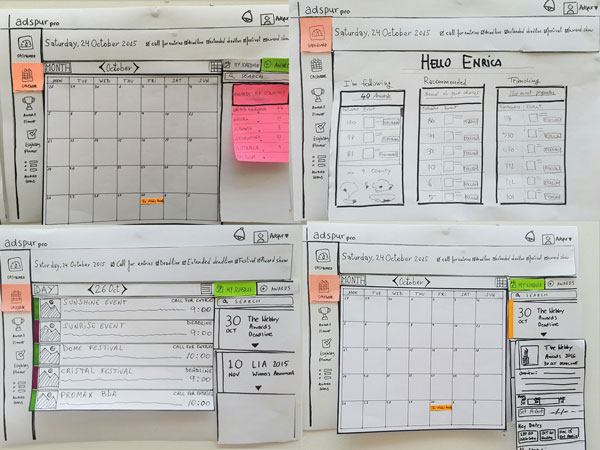
We enter an experimental phase in which ideas, assumptions and other aspects of the concept can be tested or validated. This enables the designers involved to start making the necessary adjustments or potential changes in direction.
The goal is to identify the best possible solution to each problem identified.
This can be achieved by using simple paper prototypes or by producing low-cost, scaled-down versions of the product (or specific features within it) to test the ideas we have generated.
Using these prototypes, we test our assumptions by comparing them against our hypotheses. We can also produce materials that help shape the project, such as extracting insights, identifying task affinities, defining key user profiles to create personas or avatars, site maps, content inventories, screen flows, navigation models, task flows, user journeys and scenarios. All of these artefacts help keep our efforts focused on the user before moving forward.
With this research in hand, we define the problem we are trying to solve and establish a hypothesis.

Although this is the final phase, prototypes must be tested rigorously. Design thinking is an iterative process, and test results are often used to redefine one or more additional problems. For this reason, it is often necessary to return to earlier stages to make new iterations, adjustments or refinements in order to explore or discard alternative solutions.
With each loop of the process, the fidelity of the prototypes increases. The earlier we can identify and resolve issues, the easier and less costly it is to make changes and adjustments.
As the process progresses and the fidelity of what we are building increases, changes become more expensive. This is why creating prototypes as early as possible is so important.
Testing sessions provide new insights and are repeated until a Minimum Viable Product (MVP) is achieved.
Finally, specifications are created and wireframes evolve into a complete design solution. The design is reviewed with stakeholders to gather feedback and insights.
It is important to understand that every project is different. While these steps contribute to the overall design process, they do not represent a rigid, sequential structure that can be applied in every case.
The primary goal of each project is to gain the deepest possible understanding of users and determine what their ideal solution or product would be.
© Copyright 2026 | Ignacio Jacquot – Freelance UX/UI Designer | Product Design | All rights reserved