UFC Fighter Performance
Exploratory data analysis of what really drives wins in the UFC
- Data science
- Exploratory analysis
- Data storytelling
This exploratory data analysis (EDA) asks a simple question with a data answer: which factors actually influence the performance of UFC fighters? Instead of relying on received wisdom about reach, stance or age, I framed four hypotheses and tested each one against the records of more than 3,000 fighters.
Role: question framing, data analysis, visualisation and the presentation that tells the story. The full notebook is open on GitHub.
The questions
Fight commentary is full of confident claims: the taller fighter has the advantage, southpaws are awkward to face, experience wins in the end. I wanted to see which of them survive contact with the data. The analysis is organised around four hypotheses:
- Physical characteristics: are height, weight or reach related to performance?
- Stance: which of the common guards, Orthodox, Southpaw or Switch, wins the most?
- Age: is a fighter’s age directly related to their number of victories?
- Style: are strikers more successful than grapplers?
Each hypothesis gets its own section, one question, the evidence and a plain-language conclusion, so the reader can follow the reasoning without reading code.
Data and method
The analysis uses a public dataset of UFC fighters, around 3,200 records, with physical measurements, stance, record and fight statistics. After cleaning, I derived the measures the questions needed, such as win percentage, and compared groups using correlations, averages and totals.
Where groups were very different in size I did not trust the raw totals. The Switch stance has only 192 fighters, so for the comparison of total wins I drew a balanced sample of 190 fighters per stance. The win percentage barely changed with the smaller sample, which was reassuring, while the totals told a different story.
Hypothesis 1: physique
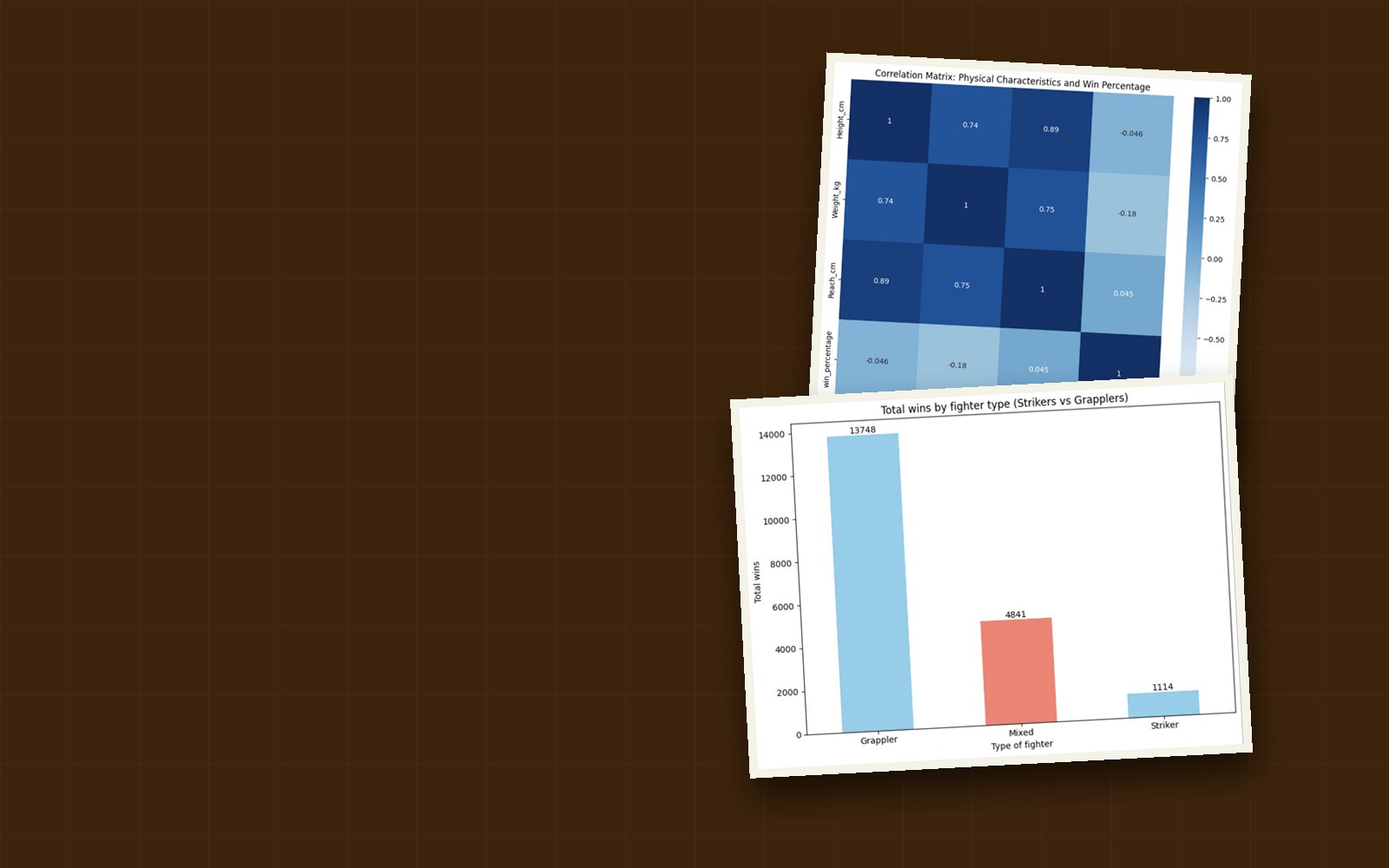
A correlation matrix shows two things at once. Height, weight and reach are strongly related to each other, as expected: height and reach at 0.89, weight and reach at 0.75, height and weight at 0.74. But their correlation with win percentage is close to zero, between roughly 0.05 and 0.18 in absolute terms.
In other words, being taller, heavier or longer-limbed does not make a fighter win more. Technique, strategy, experience and conditioning are likely to matter far more than the tape measure.
Hypothesis 2: stance
Orthodox is by far the most used guard, with 77% of fighters, followed by Southpaw at 17% and Switch at 6%. Rarer stances were excluded because there was too little data to say anything reliable about them.
Win percentage is similar across the three, with Switch slightly ahead at around 72 to 73%, which may reflect the flexibility of changing stance mid-fight. Southpaw, however, has the highest average wins per fighter. On the balanced sample it also has the highest total, despite being used by far fewer fighters than Orthodox.
The reading is nuanced: Southpaw looks the most effective in absolute terms, possibly because opponents face it less often, while Switch has a higher proportion of wins but is rarer and depends heavily on the individual fighter.
Hypothesis 3: age
Plotting age against wins shows most fighters between 20 and 60, the large majority with fewer than 50 wins, and a concentration between 30 and 50. One outlier stands out, a veteran in the 50 to 55 range with around 250 wins, evidence of an exceptionally long career rather than a pattern.
The correlation between age and number of wins is weak, at 0.18. Fighters can succeed at any age; only the very young and the oldest tend to have fewer victories, which is simply the effect of shorter or winding-down careers.
Hypothesis 4: strikers and grapplers
Fighters were classified by their statistics: grapplers by takedowns and submission attempts per fifteen minutes and takedown accuracy, strikers by significant strikes landed per minute and striking accuracy, and the rest as mixed.
This was the clearest result of the study. Grapplers have by far the most total wins, mixed fighters come second and pure strikers are a distant third. A plausible explanation is control: taking the fight to the ground reduces the risk of heavy strikes, opens the way to submission finishes and drains the opponent physically and mentally.
Conclusions
Putting the four together, the data gives a clear ranking of what matters.
- Physical characteristics show no strong link with win percentage.
- Southpaw is the most effective stance in absolute and average terms, and Switch is promising in proportion of wins, with Orthodox slightly behind.
- Age is only weakly related to wins, so success is not tied to a particular age.
- Grappling is the strongest predictor of victories of everything tested.
The study is exploratory: it shows associations, not causes, and the style classification is a simplification of how fighters really work.
Reflection
Analysis only helps if people can follow it. I wrote the study as a short visual narrative, with one question per section, one chart per idea and the conclusion stated in plain words. It is the same discipline I apply in UX: know what question the reader is asking, remove everything that does not answer it, and be honest about what the evidence can and cannot support.